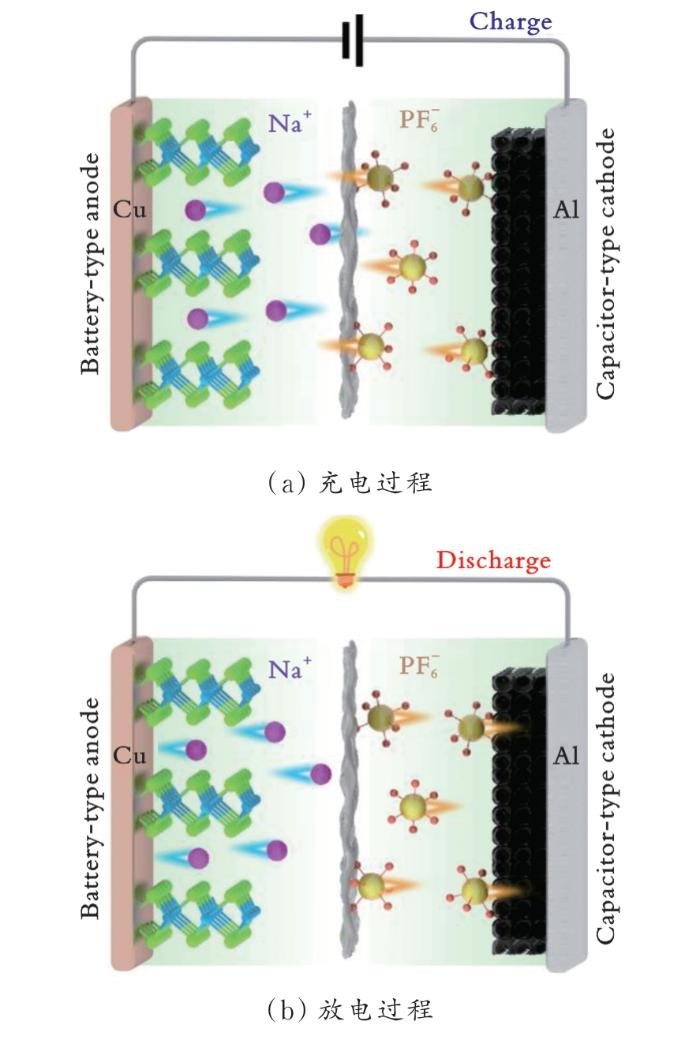
Sodium-ion capacitors represent a novel class of energy storage device that integrates the respective advantages of sodium-ion batteries and electric double-layer capacitors. Nevertheless, the mismatch between the positive and negative electrode kinetics of sodium ion capacitors can lead to their low power density and poor cycling stability. Since the advent of single-atom catalysis, single-atom metals have garnered substantial attention in energy storage research due to their high atomic efficiency, exceptional catalytic activity, superior selectivity, and remarkable stability.Firstly, the challenges faced by electrode materials for sodium ion capacitors were elaborated, and the energy storage mechanism of sodium ion capacitors was analyzed. Secondly, the characteristics of single atom catalysts and the preparation methods of carbon supported metal single atom materials were introduced. Then, the application progress of metal monatomic materials in sodium ion capacitors was summarized. Finally, the application prospects of metal single atoms in sodium ion capacitors were discussed.
20世纪60-70年代,随着表面化学和催化研究的进展,研究人员逐渐认识到在许多催化反应中只有少数表面活性位点(通常是孤立的原子或少量原子簇)起关键作用[25-27]。2011年,B.T.QIAO等[28]通过共沉淀法将孤立的单个Pt原子固定在氧化铁纳米晶体表面,成功制备了Pt1/FeO x 催化剂。这一实验首次验证了单个金属原子可以作为催化活性位点,并显著提升了原子利用率和催化性能,同时正式提出了“单原子催化”概念。2012年,G.KYRIAKOU等[29]发现,Cu表面单个Pd原子可以大大降低氢在Cu表面吸附和解吸的能垒,从而使苯乙烯和乙炔的加氢反应具有非常高的选择性。2015年,H.YAN等[30]利用原子层沉积技术在石墨烯上制备了原子分散的Pd。结果表明,在1,3-丁二烯的选择性氢化反应中,单原子Pd1/石墨烯催化剂在50 ℃左右的温和的反应条件下,表现出约100%的丁烯选择性和95%的转化率。在随后的几年里,科学家们使用更常见的过渡金属(如Fe和Co)制备了一系列单原子催化剂。2016年,P.Q.YIN等[31]通过热解预先设计的双金属Zn/Co金属-有机骨架,使Co被有机连接剂炭化还原成单原子催化剂,所获得的
Co-N x 单位点表现出优越的氧还原反应性能,同时在电化学催化中表现出优异的化学稳定性和热稳定性。2018年,R.JIANG等[32]制备了一系列具有Fe-N-C纳米结构的材料,通过实验和理论计算证实,单位点与碳基质间的优化使氧还原反应活性更强,稳定性更好,原子利用效率更高,降低了整体氧还原反应的势垒。2019年,X.Y.QIU等[33]采用模板辅助法,以酞菁铁(FePc)为前驱体,合成了锚定在石墨烯空心纳米球(Fe ISAs/GHSs)上的分离Fe单原子复合材料。结果表明,原子级分散的Fe活性位点和高度稳定的空心衬底相结合,使Fe ISAs/GHSs具有出色的氧还原反应性能、增强的活性和长期稳定性,其性能优于先进的商用Pt/C催化剂。
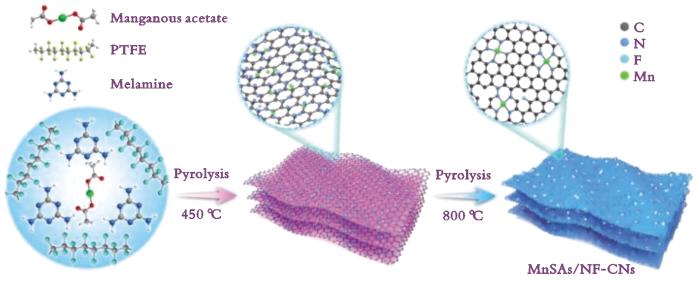
热解法由于操作简单、金属负载量较高和扩展性良好,已被广泛应用于在受控气氛的保护下对选定前驱体进行高温热解以制备碳负载单原子催化剂[40]。在高温条件下,原子热运动加剧,单原子容易相互靠近并形成团簇,因此前驱体的选择与设计至关重要。前驱体包括聚合物、金属有机框架和其他含有金属的有机化合物。其中,聚合物是应用最广泛的前驱体。H.T.CHUNG等[41]以苯乙烯和聚苯胺为双氮前驱体,合成了具有类似石墨烯形态的Fe-N-C杂化结构。结果表明,苯乙烯作为前驱体不仅可以增强氮掺杂,而且在热解过程中产生的大量气体可以促进基底成孔。除了聚合物外,金属有机框架及其衍生材料因具有可控的金属位点、丰富的有机配体和有序可调节的孔隙结构,也常被用于热解制备碳基底的前驱体[42]。金属有机框架由均匀分布的金属节点和有机连接体组成,因此可以通过预先设计的金属有机框架结构,将目标金属节点引入框架中,从而避免金属原子在高温热解过程中团聚形成纳米颗粒。L.JIAO等[43]在预先设计的卟啉型金属有机框架(Fe x -PCN-222)中,采用含/不含FeⅢ中心的四(4-羧基苯基)卟啉(TCPP)配体,延长FeⅢ在三维金属有机框架网络中的空间距离,有效抑制了铁原子在热解过程中的团聚。作为一种热驱动的化学反应,热解法反应条件难以精确控制,这可能会导致产物的形貌、大小、表面分散性等特性不均一。对于一些精细结构要求较高的材料,热解法往往难以满足生产需求。
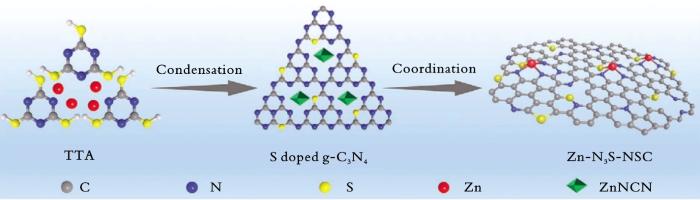
综上可知,目前湿化学合成法是较为主流的金属单原子电极材料的制备方法。该方法通过将金属单原子与杂原子形成配位(M-N x )的策略,可有效地解决制备过程中金属单原子团聚问题,进一步提高金属原子的利用率,在优化电荷结构、降低离子扩散能垒、提高离子快速反应动力学方面具有重要作用。同时,改变金属类型、引入相邻杂原子掺杂等策略也可有效地增加材料缺陷空位,促进钠离子嵌入/脱出,获得优异的电化学性能。表1为金属单原子在钠离子电容器中的应用数据。
Table 1
表1
表1金属单原子在钠离子电容器中的应用数据
Table 1 The application data of single-atom metals in sodium-ion capacitors
QU W Q, ZHAO J H, WANG S, et al. Research progress of biomass-based carbon materials for supercapacitors[J]. Low-Carbon Chemistry and Chemical Engineering, 2024, 49(10): 38-46.
ZHOU W L, WANG X Y, SHAN J W, et al. Engineering hollow core-shell hetero-structure box to induce interfacial charge modulation for promoting bidirectional sulfur conversion in lithium-sulfur batteries[J]. Journal of Energy Chemistry, 2023, 80: 128-139.
HU W, ZHAO S. Remaining useful life prediction of lithium-ion batteries based on wavelet denoising and transformer neural network[J]. Frontiers in Energy Research, 2022, 10: 969168.
MAZLOOMIAN K, LANCASTER H J, HOWARD C A, et al. Supercapacitor degradation: Understanding mechanisms of cycling-induced deterioration and failure of a pseudocapacitor[J]. Batteries & Supercaps, 2023, 6(8): e202300214.
QIANG G, NAN C, QU L T. The advance and perspective on electrode materials for metal–ion hybrid capacitors[J]. Advanced Energy and Sustainability Research, 2021, 2(7): 2100022.
SUN C K, ZHANG X, AN Y B, et al. Low-temperature carbonized nitrogen-doped hard carbon nanofiber toward high-performance sodium-ion capacitors[J]. Energy & Environmental Materials, 2023, 6(4): e12603.
CEMENTON C, RAMIREDDY T, DEWAR D, et al. We may be underestimating the power capabilities of lithium-ion capacitors[J]. Journal of Power Sources, 2024, 591: 233857.
ZHANG B, XI J X, CAO Y A, et al. Research progress of hard carbon anode of sodium-ion batteries based on visualization analysis[J]. Journal of Petrochemical Universities, 2022, 35(6): 1-9.
SHENG D W, HASEEB U D, ZHANG J Y, et al. Study on microstructure regulation and sodium storage performance of reduced graphene oxide[J]. Journal of Petrochemical Universities, 2023, 36(6): 48-56.
ZHANG X H, SUN X Z, ZHANG X, et al. Prospect of lithium-ion capacitor application in new energy field[J]. Advanced Technology of Electrical Engineering and Energy, 2020, 39(11): 48-58.
ZHAO C Y, YAO S Y, LI C, et al. Recent advances in transition metal oxides as anode materials for high-performance lithium-ion capacitors[J]. Chemical Engineering Journal, 2024, 497: 154535.
WANG J, LI Z, RAMESH S, et al. Recent advances in metal oxides for sodium-ion capacitors: Mechanism, materials, and future prospects[J]. Chemical Engineering Journal, 2023, 478: 147485.
MI C L, QIN Y Y, HUANG X L, et al. Galvanic replacement synthesis of graphene coupled amorphous antimony nanoparticles for high-performance sodium-ion capacitor[J]. Acta Physico-Chimica Sinica, 2024, 40(5): 25-27.
WANG L, WEI Z X, MAO M L, et al. Metal oxide/graphene composite anode materials for sodium-ion batteries[J]. Energy Storage Materials, 2019, 16: 434-454.
FANG G Z, WU Z X, ZHOU J, et al. Observation of pseudocapacitive effect and fast ion diffusion in bimetallic sulfides as an advanced sodium-ion battery anode[J]. Advanced Energy Materials, 2018, 8(19): 1703155.
WANG L H, YANG W Y, SHEN Z Q, et al. Synthesis,characterization and applications of noble metal single atom catalysts for chemical industry[J]. Contemporary Chemical Industry, 2023, 52(10): 2290-2298.
YU Q Q, DAI Y Z, ZHANG L, et al. Research progress of non-noble metal single-atom catalysts[J]. Environmental Protection of Chemical Industry, 2022, 42(2): 143-147.
JU Y N, ZHANG Y L, ZHANG R, et al. Study on the effect of metal dispersion on the catalytic activity of nickel-based catalysts[J]. Journal of Petrochemical Universities, 2022, 35(5): 71-77.
SHI Y T, ZHAO C Y, WEI H S, et al. Single-atom catalysis in mesoporous photovoltaics: The principle of utility maximization[J]. Advanced Materials, 2014, 26(48): 8147-8153.
WANG L L, LIU H Z, HAN B X. Advances in selective hydrogenation of biomass derivatives catalyzed by monatomic catalysts[J]. Petroleum Processing and Petrochemicals, 2024, 55(1): 52-61.
KIRLIN P S, GATES B C. Activation of the C-C bond provides a molecular basis for structure sensitivity in metal catalysis[J]. Nature, 1987, 325(6099): 38-40.
VIDAL V V, THEOLIER A, THIVOLLE-CAZAT J, et al. Metathesis of alkanes catalyzed by silica-supported transition metal hydrides[J]. Science, 1997, 276(5309): 99-102.
KYRIAKOU G, BOUCHER M B, JEWELL A D, et al. Isolated metal atom geometries as a strategy for selective heterogeneous hydrogenations[J]. Science, 2012, 335(6073): 1209-1212.
YAN H, CHENG H, YI H, et al. Single-atom Pd₁/graphene catalyst achieved by atomic layer deposition: Remarkable performance in selective hydrogenation of 1,3-butadiene[J]. Journal of the American Chemical Society, 2015, 137(33): 10484-10487.
YIN P Q, YAO T, WU Y E, et al. Single cobalt atoms with precise N-coordination as superior oxygen reduction reaction catalysts[J]. Angewandte Chemie (International ed. in English), 2016, 55(36): 10800-10805.
JIANG R, LI L, SHENG T, et al. Edge-site engineering of atomically dispersed Fe-N4 by selective C-N bond cleavage for enhanced oxygen reduction reaction activities[J]. Journal of the American Chemical Society, 2018, 140(37): 11594-11598.
QIU X Y, YAN X H, PANG H, et al. Isolated Fe single atomic sites anchored on highly steady hollow graphene nanospheres as an efficient electrocatalyst for the oxygen reduction reaction[J]. Advanced Science, 2019, 6(2): 1801103.
ZHUANG J H, WANG D S. Current advances and future challenges of single-atom catalysis[J]. Chemical Journal of Chinese Universities, 2022, 43(5): 21-37.
WANG L, CHEN M X, YAN Q Q, et al. A sulfur-tethering synthesis strategy toward high-loading atomically dispersed noble metal catalysts[J]. Science Advances, 2019, 5(10): eaax6322.
GONG W B, YUAN Q L, CHEN C, et al. Liberating N-CNTs confined highly dispersed Co-Nx sites for selective hydrogenation of quinolines[J]. Advanced Materials, 2019, 31(49): e1906051.
ZHANG J Q, ZHAO Y F, CHEN C, et al. Tuning the coordination environment in single-atom catalysts to achieve highly efficient oxygen reduction reactions[J]. Journal of the American Chemical Society, 2019, 141(51): 20118-20126.
YANG X F, WANG A Q, QIAO B T, et al. Single-atom catalysts: A new frontier in heterogeneous catalysis[J]. Accounts of Chemical Research, 2013, 46(8): 1740-1748.
YANG Y C, YANG Y W, PEI Z X, et al. Recent progress of carbon-supported single-atom catalysts for energy conversion and storage[J]. Matter, 2020, 3(5): 1442-1476.
CHUNG H T, CULLEN D A, HIGGINS D, et al. Direct atomic-level insight into the active sites of a high-performance PGM-free ORR catalyst[J]. Science, 2017, 357(6350): 479-484.
JIAO L, WAN G, ZHANG R, et al. From metal–organic frameworks to single-atom Fe implanted N-doped porous carbons: Efficient oxygen reduction in both alkaline and acidic media[J]. Angewandte Chemie, 2018, 130(28): 8661-8665.
YAN H, ZHAO X X, GUO N, et al. Atomic engineering of high-density isolated Co atoms on graphene with proximal-atom controlled reaction selectivity[J]. Nature Communications, 2018, 9(1): 3197.
ZHANG C H, SHA J W, FEI H L, et al. Single-atomic ruthenium catalytic sites on nitrogen-doped graphene for oxygen reduction reaction in acidic medium[J]. ACS Nano, 2017, 11(7): 6930-6941.
LIN L L, ZHOU W, GAO R, et al. Low-temperature hydrogen production from water and methanol using Pt/α-MoC catalysts[J]. Nature, 2017, 544(7648): 80-83.
KWAK J H, KOVARIK L, SZANYI J. Heterogeneous catalysis on atomically dispersed supported metals: CO2 reduction on multifunctional Pd catalysts[J]. ACS Catalysis, 2013, 3(9): 2094-2100.
YE C L, ZHANG N Q, WANG D S, et al. Single atomic site catalysts: Synthesis, characterization, and applications[J]. Chemical Communications (Cambridge, England), 2020, 56(56): 7687-7697.
AHN T, KIM J H, YANG H M, et al. Formation pathways of magnetite nanoparticles by coprecipitation method[J]. The Journal of Physical Chemistry C, 2012, 116(10): 6069-6076.
ZHOU J Q, YANG S R, AI F X, et al. Preparation of Co9S8@CNFs composites and their application in lithium-ion batteries[J]. Journal of Liaoning Petrochemical University, 2022, 42(6): 21-27.
XU Q, LI Y N, WU C H, et al. Kinetically accelerated and high-mass loaded lithium storage enabled by atomic iron embedded carbon nanofibers[J]. Nano Research, 2022, 15(7): 6176-6183.
XUE Y, LI Y, LUO G, et al. Using a dynamic inhibition concept to achieve content-controllable synthesis of n-coordinated Cu atoms as reversible active site toward super Li-ion capacitors[J]. Advanced Energy Materials, 2020, 10(41): 200264.
YIN X P, WANG H J, TANG S F, et al. Engineering the coordination environment of single-atom platinum anchored on graphdiyne for optimizing electrocatalytic hydrogen evolution[J]. Angewandte Chemie International Edition, 2018, 57(30): 9382-9386.
PODYACHEVA O Y, BULUSHEV D A, SUBOCH A N, et al. Highly stable single-atom catalyst with ionic Pd active sites supported on N-doped carbon nanotubes for formic acid decomposition[J]. ChemSusChem, 2018, 11(21): 3724-3727.
GUAN X Z, HAN R, ASAKURA H, et al. Subsurface single-atom catalyst enabled by mechanochemical synthesis for oxidation chemistry[J]. Angewandte Chemie International Edition, 2024, 63(42): e202410457.
HOWARD J L, CAO Q, BROWNE D L. Mechanochemistry as an emerging tool for molecular synthesis: What can it offer?[J]. Chemical Science, 2018, 9(12): 3080-3094.
JIN H Y, SULTAN S, HA M R, et al. Simple and scalable mechanochemical synthesis of noble metal catalysts with single atoms toward highly efficient hydrogen evolution[J]. Advanced Functional Materials, 2020, 30(25): 2000531.
LI X, YE W, XU P, et al. An encapsulation-based sodium storage via Zn-single-atom implanted carbon nanotubes[J]. Advanced Materials, 2022, 34(31): 2202898.
PAL P, BHOWMIK S, NANDI M. Ni single atom decorated porous hollow carbon nanosphere-based electrodes for high performance symmetric solid-state supercapacitors[J]. Chemistry, 2024, 30(39): e202400638.
YANG L, LIU P, ZHOU J. Unleashing anion chemical adsorption with pore-confined single atom zinc for enabling high-performance lithium-ion capacitors[J]. ACS Applied Energy Materials, 2023, 6(19): 10105-10115.
LIU F, MENG J S, JIANG G P, et al. Coordination engineering of metal single atom on carbon for enhanced and robust potassium storage[J]. Matter, 2021, 4(12): 4006-4021.
GAO Z Y, TAO S, ZHU L, et al. Coordination engineering of single zinc atoms on hierarchical dual-carbon for high-performance potassium-ion capacitors[J]. Journal of Colloid and Interface Science, 2023, 649: 203-213.
SHAH S S A, NAJAM T, BASHIR M S, et al. Single-atom catalysts for next-generation rechargeable batteries and fuel cells[J]. Energy Storage Materials, 2022, 45: 301-322.
XI J B, JUNG H S, XU Y, et al. Synthesis strategies, catalytic applications, and performance regulation of single-atom catalysts[J]. Advanced Functional Materials, 2021, 31(12): 2008318.
HU X, WANG G, LI J, et al. Significant contribution of single atomic Mn implanted in carbon nanosheets to high-performance sodium-ion hybrid capacitors[J]. Energy & Environmental Science, 2021, 14(8): 4564-4573.
LIU L, DU Z Z, SUN J M, et al. Engineering the first coordination shell of single Zn atoms via molecular design strategy toward high-performance sodium-ion hybrid capacitors[J]. Small, 2023, 19(21): e2300556.
LIU B, HU S, PAN Y, et al. Amorphous modulation of atomic Nb-O/N clusters with asymmetric coordination in carbon shells for advanced sodium-ion hybrid capacitors[J]. Small, 2024, 20(12): 2308263.
WANG C, LI B H, SHEN W C, et al. Unveiling the effects of Cr single atoms with controllable configurations on solid electrolyte interphase and storage mechanism of sodium ions[J]. Advanced Functional Materials, 2023, 33(18): 2214429.
SU M, PAN Z, CHONG Y, et al. Boosting the electrochemical performance of hematite nanorods via quenching-induced metal single atom functionalization[J]. Journal of Materials Chemistry A, 2021, 9(6): 3492-3499.
... 热解法由于操作简单、金属负载量较高和扩展性良好,已被广泛应用于在受控气氛的保护下对选定前驱体进行高温热解以制备碳负载单原子催化剂[40].在高温条件下,原子热运动加剧,单原子容易相互靠近并形成团簇,因此前驱体的选择与设计至关重要.前驱体包括聚合物、金属有机框架和其他含有金属的有机化合物.其中,聚合物是应用最广泛的前驱体.H.T.CHUNG等[41]以苯乙烯和聚苯胺为双氮前驱体,合成了具有类似石墨烯形态的Fe-N-C杂化结构.结果表明,苯乙烯作为前驱体不仅可以增强氮掺杂,而且在热解过程中产生的大量气体可以促进基底成孔.除了聚合物外,金属有机框架及其衍生材料因具有可控的金属位点、丰富的有机配体和有序可调节的孔隙结构,也常被用于热解制备碳基底的前驱体[42].金属有机框架由均匀分布的金属节点和有机连接体组成,因此可以通过预先设计的金属有机框架结构,将目标金属节点引入框架中,从而避免金属原子在高温热解过程中团聚形成纳米颗粒.L.JIAO等[43]在预先设计的卟啉型金属有机框架(Fe x -PCN-222)中,采用含/不含FeⅢ中心的四(4-羧基苯基)卟啉(TCPP)配体,延长FeⅢ在三维金属有机框架网络中的空间距离,有效抑制了铁原子在热解过程中的团聚.作为一种热驱动的化学反应,热解法反应条件难以精确控制,这可能会导致产物的形貌、大小、表面分散性等特性不均一.对于一些精细结构要求较高的材料,热解法往往难以满足生产需求. ...
1
... 热解法由于操作简单、金属负载量较高和扩展性良好,已被广泛应用于在受控气氛的保护下对选定前驱体进行高温热解以制备碳负载单原子催化剂[40].在高温条件下,原子热运动加剧,单原子容易相互靠近并形成团簇,因此前驱体的选择与设计至关重要.前驱体包括聚合物、金属有机框架和其他含有金属的有机化合物.其中,聚合物是应用最广泛的前驱体.H.T.CHUNG等[41]以苯乙烯和聚苯胺为双氮前驱体,合成了具有类似石墨烯形态的Fe-N-C杂化结构.结果表明,苯乙烯作为前驱体不仅可以增强氮掺杂,而且在热解过程中产生的大量气体可以促进基底成孔.除了聚合物外,金属有机框架及其衍生材料因具有可控的金属位点、丰富的有机配体和有序可调节的孔隙结构,也常被用于热解制备碳基底的前驱体[42].金属有机框架由均匀分布的金属节点和有机连接体组成,因此可以通过预先设计的金属有机框架结构,将目标金属节点引入框架中,从而避免金属原子在高温热解过程中团聚形成纳米颗粒.L.JIAO等[43]在预先设计的卟啉型金属有机框架(Fe x -PCN-222)中,采用含/不含FeⅢ中心的四(4-羧基苯基)卟啉(TCPP)配体,延长FeⅢ在三维金属有机框架网络中的空间距离,有效抑制了铁原子在热解过程中的团聚.作为一种热驱动的化学反应,热解法反应条件难以精确控制,这可能会导致产物的形貌、大小、表面分散性等特性不均一.对于一些精细结构要求较高的材料,热解法往往难以满足生产需求. ...
1
... 热解法由于操作简单、金属负载量较高和扩展性良好,已被广泛应用于在受控气氛的保护下对选定前驱体进行高温热解以制备碳负载单原子催化剂[40].在高温条件下,原子热运动加剧,单原子容易相互靠近并形成团簇,因此前驱体的选择与设计至关重要.前驱体包括聚合物、金属有机框架和其他含有金属的有机化合物.其中,聚合物是应用最广泛的前驱体.H.T.CHUNG等[41]以苯乙烯和聚苯胺为双氮前驱体,合成了具有类似石墨烯形态的Fe-N-C杂化结构.结果表明,苯乙烯作为前驱体不仅可以增强氮掺杂,而且在热解过程中产生的大量气体可以促进基底成孔.除了聚合物外,金属有机框架及其衍生材料因具有可控的金属位点、丰富的有机配体和有序可调节的孔隙结构,也常被用于热解制备碳基底的前驱体[42].金属有机框架由均匀分布的金属节点和有机连接体组成,因此可以通过预先设计的金属有机框架结构,将目标金属节点引入框架中,从而避免金属原子在高温热解过程中团聚形成纳米颗粒.L.JIAO等[43]在预先设计的卟啉型金属有机框架(Fe x -PCN-222)中,采用含/不含FeⅢ中心的四(4-羧基苯基)卟啉(TCPP)配体,延长FeⅢ在三维金属有机框架网络中的空间距离,有效抑制了铁原子在热解过程中的团聚.作为一种热驱动的化学反应,热解法反应条件难以精确控制,这可能会导致产物的形貌、大小、表面分散性等特性不均一.对于一些精细结构要求较高的材料,热解法往往难以满足生产需求. ...
1
... 热解法由于操作简单、金属负载量较高和扩展性良好,已被广泛应用于在受控气氛的保护下对选定前驱体进行高温热解以制备碳负载单原子催化剂[40].在高温条件下,原子热运动加剧,单原子容易相互靠近并形成团簇,因此前驱体的选择与设计至关重要.前驱体包括聚合物、金属有机框架和其他含有金属的有机化合物.其中,聚合物是应用最广泛的前驱体.H.T.CHUNG等[41]以苯乙烯和聚苯胺为双氮前驱体,合成了具有类似石墨烯形态的Fe-N-C杂化结构.结果表明,苯乙烯作为前驱体不仅可以增强氮掺杂,而且在热解过程中产生的大量气体可以促进基底成孔.除了聚合物外,金属有机框架及其衍生材料因具有可控的金属位点、丰富的有机配体和有序可调节的孔隙结构,也常被用于热解制备碳基底的前驱体[42].金属有机框架由均匀分布的金属节点和有机连接体组成,因此可以通过预先设计的金属有机框架结构,将目标金属节点引入框架中,从而避免金属原子在高温热解过程中团聚形成纳米颗粒.L.JIAO等[43]在预先设计的卟啉型金属有机框架(Fe x -PCN-222)中,采用含/不含FeⅢ中心的四(4-羧基苯基)卟啉(TCPP)配体,延长FeⅢ在三维金属有机框架网络中的空间距离,有效抑制了铁原子在热解过程中的团聚.作为一种热驱动的化学反应,热解法反应条件难以精确控制,这可能会导致产物的形貌、大小、表面分散性等特性不均一.对于一些精细结构要求较高的材料,热解法往往难以满足生产需求. ...
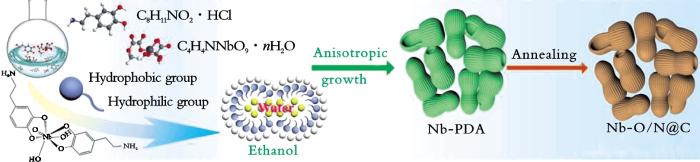
... [73]Preparation process flow of Nb-O/N@C<sup>[<xref ref-type="bibr" rid="R73">73</xref>]</sup>Fig.4
综上可知,目前湿化学合成法是较为主流的金属单原子电极材料的制备方法.该方法通过将金属单原子与杂原子形成配位(M-N x )的策略,可有效地解决制备过程中金属单原子团聚问题,进一步提高金属原子的利用率,在优化电荷结构、降低离子扩散能垒、提高离子快速反应动力学方面具有重要作用.同时,改变金属类型、引入相邻杂原子掺杂等策略也可有效地增加材料缺陷空位,促进钠离子嵌入/脱出,获得优异的电化学性能.表1为金属单原子在钠离子电容器中的应用数据. ...
... [73]Fig.4
综上可知,目前湿化学合成法是较为主流的金属单原子电极材料的制备方法.该方法通过将金属单原子与杂原子形成配位(M-N x )的策略,可有效地解决制备过程中金属单原子团聚问题,进一步提高金属原子的利用率,在优化电荷结构、降低离子扩散能垒、提高离子快速反应动力学方面具有重要作用.同时,改变金属类型、引入相邻杂原子掺杂等策略也可有效地增加材料缺陷空位,促进钠离子嵌入/脱出,获得优异的电化学性能.表1为金属单原子在钠离子电容器中的应用数据. ...